
Here’s something nobody tells you when you start learning English as an adult: your accent is not the problem.
Your pronunciation might be. But those are two very different things — and confusing them is one of the most common, and most discouraging, mistakes adult learners make.
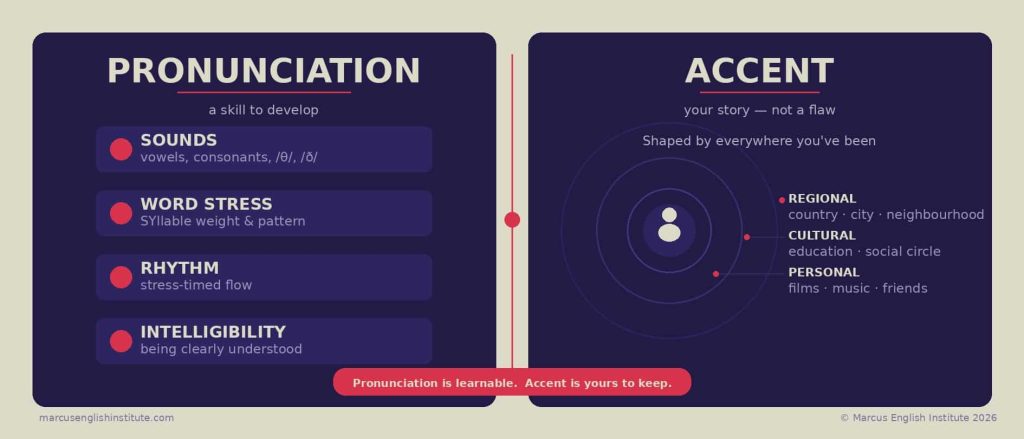
Pronunciation is about intelligibility: are you producing sounds clearly enough that people understand you? Accent is something else entirely — it’s the sonic fingerprint of where you’ve lived, who you’ve spent time with, what you’ve watched and listened to over the years. It’s not just geography. It’s biography. And there is nothing wrong with it.
This guide is about how to improve your English pronunciation as an adult — specifically, the practical mechanics of getting clearer, more confident, and more natural-sounding. Not how to sound like someone you’re not.
Before we dive in: if you want structured pronunciation work tailored to your actual speech patterns, MEI’s 1-to-1 online English lessons for adults are built around exactly this kind of personalised feedback. More on that later.
Pronunciation vs. Accent: Why the Distinction Matters
Let’s get this out of the way first, because it changes everything.
Pronunciation is about producing sounds correctly enough to be understood: vowel length, consonant clarity, word stress, sentence rhythm. These things are learnable. They can be improved with the right feedback and practice.
Accent is something different. Your accent is the accumulated result of every English environment you’ve ever been in — the city you grew up in, the friends you had at university, the shows you binged in your twenties, the colleagues who shaped how you use the language day to day. It’s not just about national origin. Two people who both grew up in Rome can sound quite different in English depending on how they’ve lived with the language.
Accent is not a flaw to be corrected. Pronunciation is a skill to be developed. Keep that distinction in mind throughout this article — and whenever anyone tries to tell you that your accent is “wrong”.
The RP Myth — and Why ‘Standard English’ Isn’t What You Think
At some point, probably in school, you were taught what “correct” English pronunciation sounds like. It was crisp, precise, a little stiff — what linguists call RP, or Received Pronunciation. Think period dramas. Think classic BBC. Think Downton Abbey.
Here’s the thing about RP: it’s spoken by somewhere between 2% and 3% of the UK population. That’s not a typo. Traditional RP — the accent most Mediterranean schools held up as the gold standard until surprisingly recently — is associated with a very narrow slice of British society: certain aristocratic and upper-class contexts, old-school BBC broadcasting, some boarding school environments. It has never been “standard” English in any meaningful sense of the word.
(If you’re a devoted RP enthusiast — and honestly, there is a romance to it — we’re not here to dim that. At MEI, we’re genuinely happy to work with students who want to develop an RP accent specifically, as a stylistic goal. It’s a valid pursuit. We just won’t pretend it’s the baseline.)
What actually matters — the thing you should be working on — is clear, natural British English pronunciation. At MEI, our tutors speak British English. Each of us has a slightly different accent: some more southern, some more northern, some shaped by years abroad. A tutor from East London, a tutor with Scottish roots, a tutor who spent years in Australia — we’d never penalise any of them for their accent, and we’d never allow a student to either. What they all share is correct British English pronunciation: sounds produced clearly, stress patterns that aid comprehension, rhythm that sounds natural to a British ear.
That’s the standard. Not RP. Not one specific regional variety. Clear, correct, comprehensible British English pronunciation.
Interested in the history and nuances of RP? We go deeper on it in our article on British English varieties — worth a read if you want the full picture.
📌 Did You Know?
English Doesn’t Work the Way You Think
In the British Isles, there are languages that are genuinely distinct from English — Welsh (spoken by around 18% of the population of Wales and co-official in the Welsh Parliament) and Scottish Gaelic, just to name a couple of the most well-known examples. Everything else — what we call British English — is a continuum of regional accents and varieties, none of which carries any greater normative authority than the others.
This is fundamentally different from how Romance languages work for example. French has the Académie française. Italian has the Accademia dell Crusca and a long tradition rooted in literary Tuscan. English has nothing equivalent — there is no official body that decides what “correct English” sounds like.
And RP? The term was only coined in the late nineteenth century, and for the first thousand years of English in Britain there was nothing resembling a “standard” accent. RP developed as a class marker among the Victorian aristocracy and public schools, was adopted by the BBC in 1922 as a broadcasting standard, and from there — carried by the cultural reach of empire — became “the English” taught to the rest of the world. Today fewer than 3% of British people speak it, and the BBC stopped requiring it of its presenters in the 1960s — over sixty years ago, and after barely 40 years of use.
In short: RP was never the norm. It was the sound of power in a very specific historical moment.
Why Adults Struggle with English Pronunciation (The Real Reasons)
It’s not your ears, and it’s not your mouth. Here’s what’s actually going on.
Your Native Language Has Already Wired Your Sound System
By the time you’re an adult, your brain has spent decades fine-tuning its ability to produce and perceive the sounds of your native language. Italian ears hear the world in Italian phonemes; French mouths have learnt to position themselves for French sounds. English requires different things — different vowel positions, different consonant endings, different stress patterns — and your existing wiring sometimes resists this.
The good news: adult brains are absolutely capable of learning new sounds. They just need deliberate, targeted practice — not vague repetition.
Nobody Has Ever Corrected You
Most adults learn English in situations where correction rarely happens. Colleagues are polite. Native-speaking friends let things slide. Group classes move too fast for individual feedback. The result: errors get practised in, repeated until they feel natural, and eventually fossilise.
Fossilised pronunciation errors — sounds you’ve been producing incorrectly for so long they feel right — are the hardest thing to shift. Which is exactly why they need targeted, expert correction rather than more passive exposure.
You’re Focused on the Wrong Things
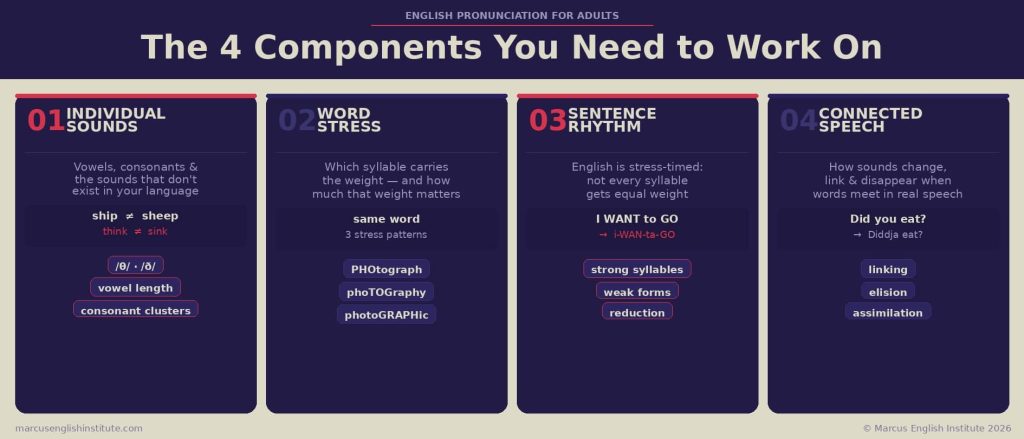
Most pronunciation guides will give you a list of ‘tricky English sounds’ and tell you to repeat them. That’s not entirely wrong, but it’s incomplete. Pronunciation is not just about individual sounds — it’s about word stress, sentence rhythm, connected speech, and the way sounds change when they bump up against each other in real sentences. Studying sounds in isolation is a starting point, not a solution.
The Most Common Pronunciation Mistakes by Language Background
Different native languages create different pronunciation challenges in English. Here’s a quick diagnostic by background:
Italian Speakers
Italian is a relatively phonetic language with regular vowel sounds and a tendency to add vowels to the ends of consonant clusters. Common issues in English: inserting vowel sounds where they don’t belong (“a-school” instead of “school”), difficulty with certain consonant clusters like /str/ or /spr/, and vowel length — English vowel distinctions (ship vs. sheep, bit vs. beat) are more extreme than Italian equivalents.
French Speakers
French has a relatively flat stress pattern compared to English, which is stress-timed and rhythmically irregular. French speakers often give equal weight to each syllable in English, producing a rhythm that sounds mechanical. The /h/ sound is also a classic challenge — and the English /th/ sounds (both the voiced version in this and the unvoiced in think) don’t exist in French at all.
Spanish Speakers
Spanish and English share many letters but use them very differently. The Spanish speaker’s /b/ and /v/ distinction doesn’t exist in Spanish, making it a common stumbling block. Vowel sounds in English are far more varied and context-sensitive than Spanish vowels. Word-final consonants — particularly /t/, /d/, /s/ in clusters — are often dropped or softened.
German Speakers
German speakers tend to over-aspirate English consonants (a hard /p/ in English words where English would use a softer version) and often add a hard glottal stop before vowel-initial words. The th sounds are a shared challenge with French speakers. On the upside: German speakers typically handle English consonant clusters and word-final consonants far better than Romance language speakers.
The point isn’t to give you a complete phonetics breakdown — it’s to show that pronunciation challenges are specific, and that generic advice is therefore limited. A French speaker and an Italian speaker learning English need to work on different things.
How to Improve English Pronunciation as an Adult: Techniques That Actually Work
1. Shadowing
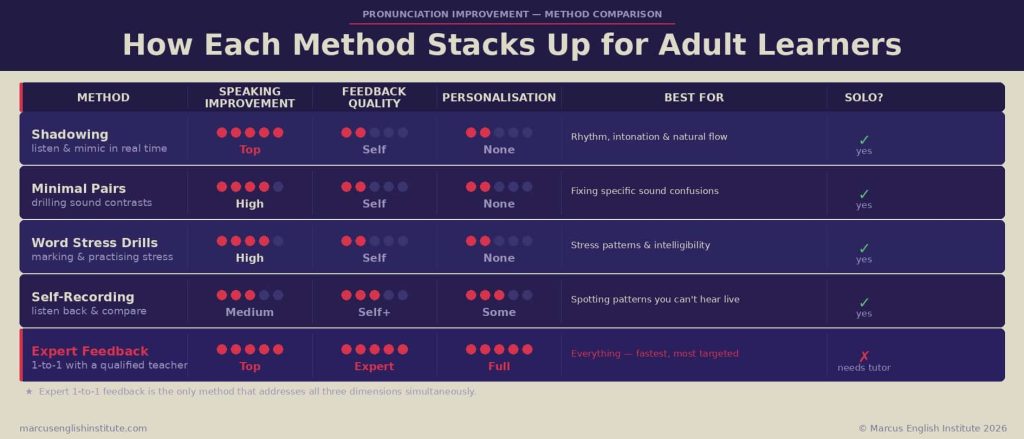
If there’s one technique that genuinely transforms pronunciation, it’s shadowing. The method: listen to a native speaker, and simultaneously repeat what they’re saying — mimicking not just the words but the rhythm, the intonation, the pace, the way sounds run together. You’re not translating or thinking; you’re borrowing someone else’s mouth for a few minutes.
It’s uncomfortable at first. Do it anyway. Ten to fifteen minutes of disciplined shadowing per day — with good material and real focus — will produce results that hours of passive listening won’t.
2. Minimal Pairs Practice
Minimal pairs are words that differ by a single sound: ship/sheep, bit/beat, think/sink, then/den. Drilling these trains both your production and your perception of the contrast — because if you can’t hear the difference, you can’t reliably produce it. Minimal pairs practice is specific, measurable, and effective. Unlike many pronunciation activities, you’ll know when it’s working.
3. Word Stress — Urgently
English is a stress-timed language. Certain syllables in every word carry weight; others are reduced almost to nothing. Get the stress wrong, and native speakers often genuinely don’t recognise the word — even if every individual sound is correct.
Examples: PHOtograph vs. phoTOGraphy vs. photoGRAPHic. Same letters, completely different stress — and all three are common English words. Whenever you learn a new word, learn its stress pattern at the same time. Mark it. Practise it. Don’t leave it to instinct.
4. Connected Speech — How Real English Actually Sounds
Written English and spoken English are not the same language. In natural speech, sounds blend, reduce, link, and sometimes disappear entirely. ‘Did you eat?’ becomes something closer to ‘Diddja eat?’. ‘I want to go’ becomes ‘I wanna go’. Understanding and producing these patterns — linking, elision, assimilation, weak forms — is what makes the difference between technically correct and naturally fluent.
5. Recording Yourself
Most people hate doing this. Do it anyway. Your internal perception of how you sound is almost certainly inaccurate — we all hear ourselves differently to how others hear us. Recording yourself speaking, then listening back critically (ideally with a tutor), is one of the fastest ways to identify specific patterns you wouldn’t otherwise notice.
6. Getting Consistent Expert Feedback
All of the above techniques have one thing in common: they’re most effective when someone who knows what they’re doing is watching and correcting you. You can shadow for months and reinforce the wrong patterns. You can drill minimal pairs and still not perceive the contrast you’re working on. Expert feedback — from a qualified teacher with experience in adult learners and an ear trained for pronunciation work — is not a nice-to-have. It’s the engine.
At MEI, pronunciation work is built into every 1-to-1 session, not treated as a separate topic. Your tutor tracks your specific patterns, assigns targeted practice between sessions, and gives you the kind of real-time correction that actually changes behaviour. You can book a free Chemistry Call here to find out if we’re a good fit.
Sounds That Cause the Most Trouble for European Adults
Some English sounds are genuinely difficult — not because you’re not trying, but because they don’t exist in most European languages.
The /θ/ and /ð/ Sounds (TH)
The infamous th. There are two versions: the unvoiced /θ/ in think, three, bathroom (tongue between teeth, no voice) and the voiced /ð/ in this, they, breathe (same position, but voiced). French, Italian, German, and Spanish speakers all tend to replace these with /s/, /z/, /t/, or /d/. This is one of the most consistently correctable pronunciation issues with dedicated practice.
Vowel Length Distinctions
English distinguishes between short and long vowel sounds in ways that matter for meaning: ship/sheep, bit/beat, not/note, full/fool. Many European languages don’t make these distinctions as sharply, so learners approximate, and native speakers sometimes misunderstand. These take ear training as much as mouth training.
Final Consonants and Consonant Clusters
English words can end in complex consonant clusters that simply don’t exist in Italian, French, or Spanish: strengths, texts, prompted. The temptation is to add a vowel, shorten the cluster, or drop consonants. In professional English, these endings matter.
The /w/ vs /v/ Distinction
Several European languages don’t make this distinction. The result: wine/vine, wet/vet, west/vest get confused. The /w/ in English is a vowel-like glide made with rounded lips; the /v/ requires the top teeth on the lower lip. They’re physically distinct — they just need to be practiced enough to become automatic.
Building a Pronunciation Practice Routine That Fits Your Life
Good news: you don’t need hours a day. You need consistency and purpose.
Here’s a realistic weekly routine for an adult learner focused on pronunciation improvement:
- 1 × 50-minute lesson with your tutor — speaking, real-time correction, pronunciation-specific drills
- 10-15 minutes of shadowing daily (podcast, video, a scene from a show — with full attention, not background noise)
- 5-10 minutes of minimal pairs or word stress drills, 3-4 days per week
- Monthly self-recording: record 2-3 minutes of natural speech and compare to the previous month
That’s roughly 3-4 hours per week, most of it independent. The 1-to-1 lesson is where your tutor sets the direction — identifies what you should be drilling, which sounds to focus on, which patterns to break. The independent practice is where you do the reps. Structured self-study with a qualified navigator is a completely different thing from winging it alone.
Should You Try to Lose Your Accent?
This comes up constantly, so let’s deal with it directly.
No. Not because it’s impossible — with enough time and immersion, accents do shift — but because it’s almost certainly not what you actually need.
What most adult learners describe as ‘wanting to lose their accent’ is usually one of two things: wanting to be understood more easily (that’s a pronunciation goal), or wanting to sound more ‘native’ (which is a different conversation, and a more complicated one).
Intelligibility is a reasonable and achievable goal. Eliminating your accent entirely is both unlikely and unnecessary — and, frankly, a little sad. Your accent is not a liability. In most professional and social contexts, a non-native accent is entirely unremarkable, as long as pronunciation is clear. Thousands of the most respected English speakers in the world have non-native accents. The idea that you need to sound like you were born in Surrey to be taken seriously in English is a relic of a very specific, very outdated cultural attitude.
Focus on pronunciation. Let the accent be what it is.
How Long Does It Take to Improve English Pronunciation as an Adult?
Depends, of course, on where you’re starting from, how specific the issues are, and how consistently you practice. But here’s a realistic breakdown:
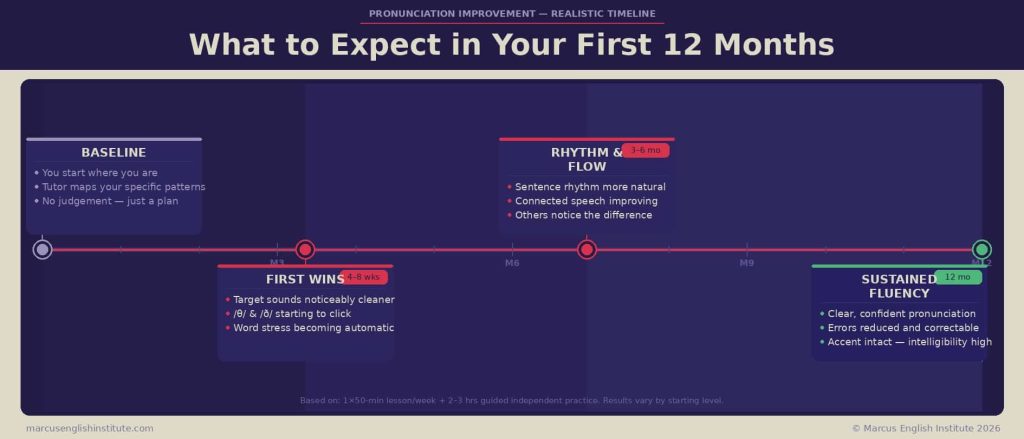
- Isolated sounds (like the /θ/): noticeable improvement in 4-8 weeks of targeted work
- Word stress patterns: awareness improves quickly (weeks); automaticity takes months
- Sentence rhythm and connected speech: typically 3-6 months of regular practice before it starts to feel natural
- Overall pronunciation profile: meaningful, sustained improvement is measurable within 6-12 months with structured lessons and independent practice
Consistency matters far more than intensity. Fifteen minutes of focused shadowing every day will get you further than a two-hour pronunciation binge on a Sunday.
Of course, if you can afford it, you can get a specialised dialect coach and work on your accent only. That would indeed shrink the timeline to just a few months.
How MEI Approaches Pronunciation Work
At MEI, pronunciation is not a separate module you sign up for — it’s woven into every lesson because it’s part of every conversation. Your tutor listens to how you speak, identifies your specific patterns (not generic Italian-speaker or French-speaker patterns — yours, specifically), and gives you targeted correction and practice assignments tailored to your profile.
Every MEI tutor holds the Cambridge CELTA and has at least ten years of experience teaching adult learners. They’re trained to hear the difference between an accent and a pronunciation issue — and they won’t try to flatten one while fixing the other.
If you want to know where you actually stand before committing to anything, our free online English test gives you a clear starting point. From there, a Chemistry Call with one of our team will map out what focused pronunciation work in your lessons would actually look like.
FAQ — Frequently Asked Questions About Improving English Pronunciation
Is it possible to improve your English pronunciation as an adult?
Yes — completely. Adult learners can make significant, lasting improvements to their English pronunciation with targeted practice and expert feedback. The challenge is that adults have established speech habits that need deliberate reprogramming, which is why passive exposure (watching shows, listening to podcasts) rarely moves the needle on its own. Structured work with a qualified teacher does.
What’s the difference between pronunciation and accent in English?
Pronunciation refers to the production of sounds, word stress, rhythm, and intonation — the technical mechanics of how you speak. Accent is the broader pattern shaped by your background, your environment, your influences. You can have a strong regional or national accent and excellent pronunciation. You can also have near-perfect pronunciation and still retain your accent. The goal is clear pronunciation; the accent is yours to keep, at least at first..
Is RP (Received Pronunciation) the correct standard for English?
Yes, inside Downton Abbey. Jokes aside, no — despite what some language courses (particularly in Mediterranean countries) have historically taught. RP is spoken by a very small minority of British speakers and is associated with specific social and institutional contexts. What matters is clear, correct British English pronunciation — not any single accent or variety. If mastering RP is a personal stylistic goal, that’s a valid pursuit; it’s just not a requirement for intelligibility or professional fluency.
How many minutes a day should I practice English pronunciation?
Ten to fifteen minutes of focused, deliberate practice — shadowing, minimal pairs, or word stress drills — done daily is significantly more effective than longer sessions done sporadically. Consistency is the variable that matters most. Even five concentrated minutes is more useful than an hour of passive listening.