
You studied English at school. You passed the exams. You can read a menu, survive an airport, and understand most of a film — as long as subtitles are available. But the moment someone actually speaks to you in English, your brain does something infuriating: it goes completely blank.
If that sounds familiar, you’re not struggling with English. You’re struggling with the wrong kind of English practice. And there’s a significant difference.
This guide is for adults who want to learn to speak English — not just understand it, not just pass a test, but actually use it confidently in real situations. We’ll cover why adults learn differently, which methods actually work, and how to build a study plan that fits into a real life with real time constraints.
Before diving in: if you already know what you need and want a more direct route, check out MEI’s 1-to-1 online English lessons for adults. They’re built specifically for people in exactly this situation.
Can Adults Really Learn to Speak English Fluently?
Short answer: yes. The longer answer requires dismantling a myth that has discouraged an entire generation of adult learners.
The idea that there’s a “critical period” for language acquisition — a window in childhood after which meaningful progress becomes nearly impossible — has been significantly overstated in popular culture. Yes, children acquire language differently than adults. But adults have advantages that children simply don’t: we have context, we have motivation, we have existing knowledge frameworks to map new language onto, and we can study with intention.
The real obstacle isn’t age. It’s method. Most adults spend years “learning” English through approaches that were never designed to produce spoken fluency — grammar drills, vocabulary lists, app streaks, passive listening. These things have their place, but none of them will help you when a client from London rings you unexpectedly at 3pm on a Tuesday.
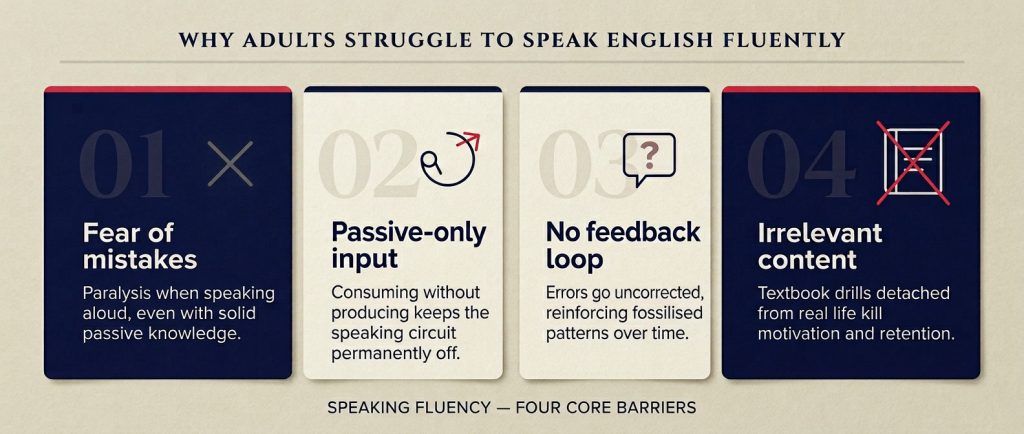
Why Adult Learners Struggle to Speak English (Even After Years of Study)
Understanding why you’re stuck is the first step to getting unstuck. Here are the real culprits.
Fear of Making Mistakes
Children don’t care about making mistakes. Adults care enormously. The fear of saying something wrong — wrong grammar, wrong pronunciation, wrong word — creates a mental block that freezes production entirely. Ironically, this fear is strongest in people who already have intermediate knowledge. Beginners don’t know enough to be self-conscious; advanced speakers have moved past it. The messy middle is where the paralysis lives.
Too Much Input, Not Enough Output
Watching Netflix in English is not a study plan. It’s procrastination with subtitles. The same goes for listening to podcasts, reading articles, and scrolling through English-language social media. All of these things build passive comprehension — and passive comprehension matters — but speaking is an active skill. The only way to get better at it is to actually do it, with feedback.
No Corrective Feedback
Most adult learners practice English in situations where no one corrects them. Colleagues nod politely. Native speaker friends let errors slide to avoid awkwardness. Language exchange partners are themselves learners. Without consistent, expert correction, fossilised errors — mistakes that have become so ingrained they feel natural — cement themselves permanently.
A Mismatch Between What You Study and What You Need
A healthcare professional in Berlin needs very different English from a sales manager in Lyon or a professor in Madrid. Generic courses and apps don’t make this distinction. They teach to a hypothetical average learner, which means they’re usually irrelevant to the actual situations where you need English most.
How Adults Learn Languages Differently — and How to Use That to Your Advantage
Adult learners aren’t worse at language acquisition — they’re different. And once you understand how, you can design a study approach that plays to your strengths.
Adults learn better when content is immediately relevant. A child will repeat a word fifty times without understanding why. You won’t — and you shouldn’t have to. Connecting new language to real contexts, real professional needs, real conversations you actually want to have, dramatically accelerates acquisition.
Adults also bring a huge existing knowledge base. Your understanding of grammar in your native language, your grasp of how professional communication works, your awareness of cultural nuance — these are assets. A skilled teacher can leverage them rather than ignoring them.
The Most Effective Methods to Learn to Speak English as an Adult
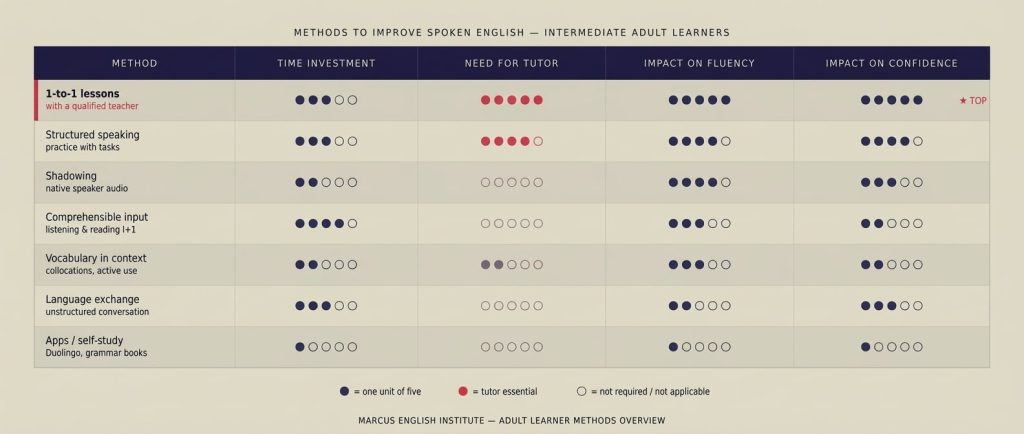
Not all methods are equal, and not all are suitable for adults with full lives and specific goals. Here’s an honest breakdown.
1-to-1 Lessons with a Qualified Teacher
This is, without question, the most effective approach for adult learners who need real results. Here’s why: every session is built around you. Your vocabulary gaps, your pronunciation issues, your specific professional context, your pace. You get immediate feedback, structured progression, and the kind of targeted speaking practice that actually builds fluency.
The key word in that sentence is “qualified.” There’s a significant difference between a native speaker who teaches casually and a Cambridge CELTA-certified teacher with years of adult education experience. The former will make you feel comfortable; the latter will make you genuinely improve.
Structured Speaking Practice (Not Just Conversation)
Unstructured conversation practice — language exchanges, casual chats with native speakers — has value, but it tends to plateau quickly. You get comfortable saying the same things in the same slightly-wrong way, and no one challenges you. Structured speaking practice is different: it means practicing with a purpose, tackling specific scenarios (presentations, negotiations, phone calls, job interviews), getting corrected in the moment, and being pushed outside your comfort zone deliberately.
Comprehensible Input at the Right Level
Linguist Stephen Krashen’s input hypothesis — the idea that we acquire language when we understand messages slightly above our current level — holds up remarkably well in practice. This means: don’t only watch content you fully understand (too easy) and don’t only consume content you barely follow (too hard). Aim for material where you understand roughly 80-85% and have to work a little for the rest.
Shadowing for Pronunciation and Rhythm
Shadowing is one of the most underused techniques for adult learners: you listen to a native speaker and simultaneously repeat what they’re saying, mimicking intonation, rhythm, and pronunciation in real time. It’s uncomfortable at first and extremely effective for building natural-sounding spoken English. Five to ten minutes a day of disciplined shadowing practice can produce noticeable improvement within weeks.
Vocabulary in Context, Not Lists
Memorising word lists is one of the least efficient ways to build usable vocabulary. Words learned in isolation rarely make it into spontaneous speech because you’ve learned the word without the surrounding patterns — the collocations, the register, the situations where it sounds natural. Learn vocabulary through reading and listening, and then actively use new words in structured speaking practice within 24 hours of encountering them.
How to Build an English Study Plan That Actually Fits Your Life
Most adult learners fail not because they lack motivation but because they fail to build a realistic plan. Enthusiasm is not a study plan. Here’s a framework that works.
Start with a Specific Goal, Not a Vague One
“I want to improve my English” is not a goal. It’s a wish. “I want to handle client calls in English without preparing a script” is a goal. “I want to pass the Cambridge CAE exam by October” is a goal. “I want to give a presentation in English at the conference in June” is a goal. Specificity determines your study focus, your methods, and your timeline.
Work Out How Much Time You Can Realistically Commit
Consistency beats intensity. Three focused 30-minute sessions per week over six months will produce dramatically better results than two marathon sessions followed by weeks of nothing. Be honest with yourself about your schedule and build a plan that respects it.
A realistic minimum for meaningful spoken progress: two to three hours of structured activity per week. Crucially, this doesn’t mean two to three hours of paid tutor time. It means two to three hours of purposeful practice — a mix of your live sessions and the guided exercises, drills, and activities your tutor assigns between lessons. Think of the tutor as the engine of your progress: they diagnose your weaknesses, build your weekly practice plan, monitor what’s working, and adjust as you improve. You do a significant chunk of the work independently — but never blindly.
Mix Active and Passive Study
A solid weekly English routine for an adult learner might look like this:
- 1 x 50-minute 1-to-1 lesson (speaking, grammar, feedback)
- 2-3 x 15-minute shadowing sessions
- Daily listening: a podcast, a short video, a news article in English (20-30 min)
- Weekly vocabulary review using spaced repetition (Anki or similar — 10-15 min)
That’s roughly three hours. At the very least one of those — the live 1-to-1 lesson — requires a tutor to be present and guiding. The rest you do independently, but with a clear plan: your tutor assigns the shadowing material, chooses the vocabulary focus, tracks your progress each week, and updates your practice activities based on what you worked on together. It’s guided self-study, not guesswork. Most European professionals can find three hours a week without disrupting their lives — especially when two of them happen on the commute, at lunch, or during a walk.
Common Mistakes Adult English Learners Make (and How to Avoid Them)
Waiting Until You Feel “Ready” to Speak
There is no point at which you will magically feel ready. Fluency is not a destination you arrive at and then start speaking — it’s something you build through speaking imperfectly, repeatedly, until the imperfections reduce. The speaking must come first.
Translating Mentally Instead of Thinking in English
One of the biggest obstacles to spoken fluency is the habit of mentally formulating sentences in your native language first, then translating. This is understandable — it’s a natural early-stage strategy — but it’s also a ceiling. The goal is to start thinking in English directly, which only happens through consistent immersive practice and, over time, begins to feel surprisingly natural.
Focusing on Grammar at the Expense of Communication
Grammar matters. But perfect grammar is not the goal — effective communication is. Native speakers make grammatical errors constantly and communicate perfectly well. Many intermediate adult learners can recite grammar rules but can’t order a coffee without a minor internal crisis. Prioritise communication first; grammar consolidates naturally through exposure and correction.
Trying to Learn to Speak Without Actually Speaking to Anyone
Apps, workbooks, grammar exercises — these are supplementary tools. They cannot replace actual human interaction. If speaking is your goal, speaking practice must form the core of your study, not an occasional add-on. This sounds obvious. It isn’t how most people study.
Online English Lessons vs. In-Person: What Works Better for Adults?
A question that came up constantly during and after the pandemic. Here’s the honest answer: for most adults, online lessons work just as well — and in many cases better.
Online learning removes the commute, allows access to a global pool of qualified teachers (not just whoever is available within 10km of your home), and fits naturally into a professional schedule. For adults learning to speak English specifically, video-based lessons are particularly effective — you’re practicing a communication skill that includes facial expressions, turn-taking, and real-time comprehension, all of which are present in an online lesson.
The caveat: online learning requires self-discipline. Without a fixed location and the social pressure of a classroom, it’s easy to cancel. Committing to a regular schedule with a consistent teacher solves most of this — you’re accountable to a person, not just a calendar entry.

What Actually Makes the Difference: The MEI Approach
Most English schools are built for volume — cohorts of students moving through a standardised curriculum at a standardised pace. For an adult with specific goals and a specific starting point, this is a poor fit.
At Marcus English Institute, every learner gets a programme built around their actual needs. All tutors hold the Cambridge CELTA qualification with at least ten years of adult teaching experience. Sessions are one-to-one, online, and built around your schedule — not a fixed timetable. Whether you need business English for a specific professional context, exam preparation for a Cambridge qualification, or simply the confidence to hold a conversation without your brain stalling, the programme adapts to that.
The results speak for themselves: a 99.8% satisfaction rate, over 20,000 classes delivered, and a 5/5 rating across three independent review platforms. But more importantly, learners report the thing they came for — actually being able to speak English in situations that matter.
If you’re ready to try it, you can book a free trial class here — no commitment, no hard sell.
How Long Does It Take to Learn to Speak English as an Adult?
Any answer that gives you a precise number of months is either lying or selling something. The honest answer is: it depends on your starting level, your goal, your method, and how consistently you practice.
That said, here’s a rough framework based on the Common European Framework of Reference (CEFR):
- A1 to B1 (basic to intermediate): roughly 250–400 hours of structured learning
- B1 to B2 (intermediate to upper-intermediate): roughly 150–250 additional hours
- B2 to C1 (upper-intermediate to advanced): roughly 200–300 additional hours
Before those numbers frighten you: they refer to structured learning time in total — not hours spent sitting across from a tutor. A significant portion of that time can be carried out independently, through tutor-assigned practice: targeted exercises, specific listening tasks, pronunciation drills, vocabulary work. Your tutor decides what you practice, tracks how it’s going, and updates the plan every week based on where you’re improving and where you’re still stuck. It’s self-study with a navigator — which is an entirely different thing from self-study alone. With that kind of structure, a learner moving from B1 to B2 can expect meaningful, noticeable improvement within six to twelve months. Often less.
Learning to Speak English for Professional Contexts: What’s Different
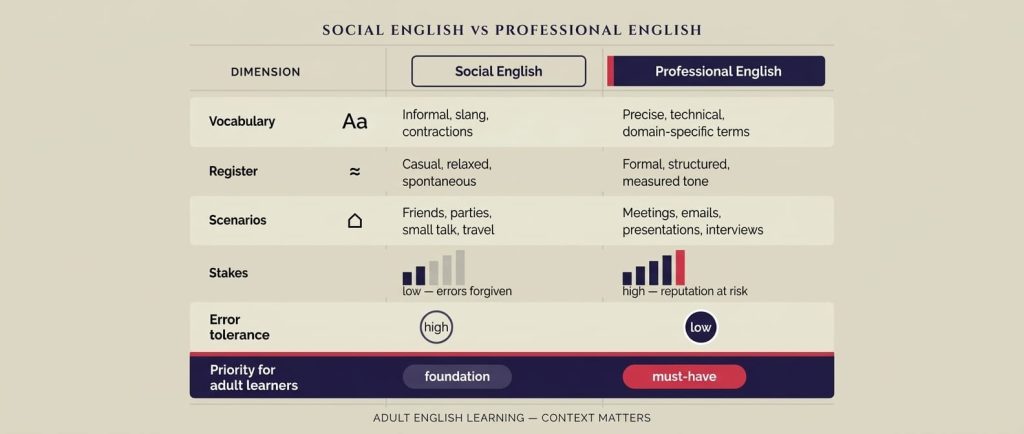
This is the topic most guides skip — and it’s the one most relevant to adult learners in Europe. Speaking English socially and speaking English professionally are related but distinct skills.
Professional English requires more than vocabulary. It demands precision, an understanding of register (formal vs. informal, direct vs. diplomatic), the ability to manage misunderstandings gracefully, and the confidence to hold your position in a discussion conducted in your second language. These are skills that don’t emerge from general language practice — they need to be specifically targeted.
If your goal is professional fluency — presentations, negotiations, client relationships, job interviews conducted in English — make sure your study plan reflects that specifically. Generic coursebooks won’t cut it. You need practice in the exact scenarios you’re going to face, with corrective feedback from someone who understands the professional context.
FAQ — Frequently Asked Questions About Learning English as an Adult
Is it too late to learn to speak English as an adult?
No. Age is not the primary barrier to learning English — method is. Adults learn differently from children, but they bring significant advantages: stronger analytical ability, clearer motivation, broader contextual knowledge. With the right approach, meaningful spoken fluency is achievable at any adult age.
How many hours per week do I need to learn to speak English?
A realistic minimum is around two to three hours of structured activity per week — but this doesn’t mean two to three hours of paid lesson time. It means one live session with your tutor plus the targeted practice they assign for the days in between: specific exercises, drills, and activities calibrated to your current level and goals. Your tutor monitors your progress, updates the plan weekly, and ensures every practice hour is purposeful. Consistency over time matters far more than occasional intensive sessions.
What is the fastest way to learn to speak English as an adult?
Regular 1-to-1 sessions with a qualified teacher, combined with deliberate speaking practice between sessions, is consistently the fastest route. It concentrates the most effective elements — personalisation, corrective feedback, structured output — in a format that fits an adult’s schedule and attention span.
Can I learn to speak English fluently online?
Yes. Online learning, particularly video-based 1-to-1 lessons, is highly effective for spoken English development. You practice the same communication skills — real-time comprehension, spoken production, turn-taking — that you’d use in any real-world English conversation. The additional benefit is flexibility and access to a much wider pool of qualified teachers.
Why do I freeze when I need to speak English in real situations?
This is usually a combination of two things: insufficient speaking practice (meaning your brain hasn’t automated the production process enough to handle real-time pressure) and performance anxiety. Both improve with the same solution: more frequent, lower-stakes speaking practice with a supportive but demanding teacher who pushes you into difficult moments deliberately, in a safe environment.
What’s the difference between learning English online with an app vs. a teacher?
Apps can help with vocabulary retention and basic comprehension. They can’t give you real-time corrective feedback on spoken production, adapt to your specific professional needs, or push you through the barriers that genuinely prevent you from speaking. A qualified teacher does all three. Think of apps as supplementary — useful additions to a real learning plan, not replacements for one.